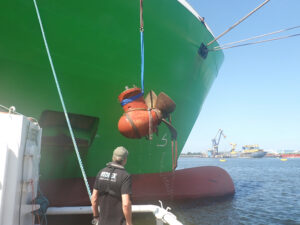
Two vessels with serious hull damage were recently repaired in Dakar, Senegal, demonstrating once again how complex steel repairs can be carried out while ships remain afloat. By mobilizing experienced teams and specialized equipment, we were able to stabilize damaged structures and carry out permanent repairs without requiring the vessels to enter drydock.
Both projects involved different types of hull damage and required tailored repair methods. In each case, the work was performed in close cooperation with the vessel’s representatives, classification society surveyors and local partners.
Immediate stabilization of damaged hull plating
The first intervention involved a tanker that had sustained hull damage and required structural reinforcement. When we arrived on site, the priority was to stabilize the affected areas and restore the integrity of the hull.

After mobilizing our team and equipment to Dakar, preparations began immediately. Four steel plates were fabricated locally and prepared for installation while additional personnel and equipment were on the way and arrived shortly afterwards. Because the vessel’s location was accessible only by water, our team worked from a workboat during the operation.

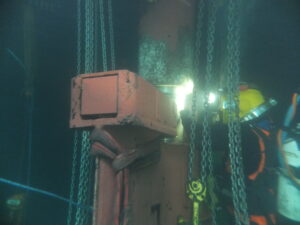
The four doubler plates had been constructed using exact measurements to follow the contours of the hull plating. The were carefully installed over the damaged areas of the hull and secured with screwdogs to ensure a tight fit. A neoprene sealing layer was applied around the edges before the plates were fully welded in place.

Additional brackets were then installed to reinforce the structure and ensure the strength of the repair. Once the welding was completed, the screwdogs were removed and the areas were inspected by our divers to confirm the integrity of the installation.
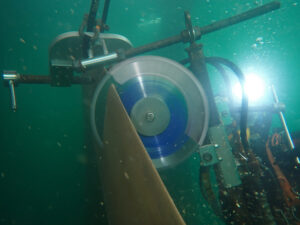
Permanent insert repairs on LNG carrier
Shortly afterwards, a second vessel required more extensive structural repairs while anchored in Dakar. The ship had suffered severely deformed and cracked hull plating on the starboard side of a water ballast tank.
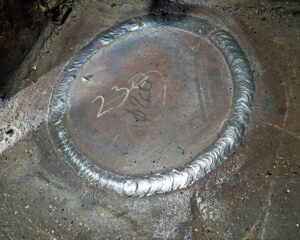
After consultation with the attending classification surveyor, it was decided that the damage would be repaired by installing two permanent insert plates in the vessel’s shell plating. The work was carried out according to our class-approved welding procedure.
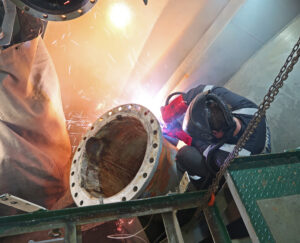
To create a dry and controlled workspace, our team designed and fabricated two cofferdams that were installed over the damaged sections of the hull. These cofferdams allowed the repair team inside the vessel to safely remove the damaged plating and prepare the area for the new inserts.
Prefabricated insert plates were then positioned and welded in place using full penetration welds from inside the vessel. After welding, non-destructive testing was carried out by an independent surveyor to verify the quality of the work. The internal structural frames were subsequently reinstalled and inspected before the cofferdams were removed.
Complex steel repairs without drydock
Both projects highlight how serious hull damage can be addressed effectively while vessels remain afloat. By combining underwater operations with internal steel work, we are able to carry out both temporary reinforcements and permanent structural repairs without requiring a drydock visit.
This type of work relies on careful preparation and established repair procedures. Our teams mobilize with specialized equipment, and we work closely with the vessel’s crew, classification surveyors and local partners to ensure every step is carried out safely and efficiently. Class-approved procedures, experienced welders and divers, and thorough inspection methods such as non-destructive testing all play an important role in delivering reliable results.
Because of this combination of engineering expertise, underwater capability and practical on-site execution, we are able to perform complex hull repairs when vessels remain at anchorage or in port. For shipowners, this means that unexpected damage can be addressed quickly, allowing vessels to return to normal operations without the delays and logistical challenges associated with an emergency drydocking.
In both of these cases, we were contacted based on previous positive experiences working with our teams. Having already seen how we approach complex repairs and how we cooperate with crews and classification societies, they knew they could rely on us again when new challenges arose.
If ever you need assistance with the underwater part of your vessel, give us a call. We can then tell you if the repair is feasible and start working on its handling.
+32 3 213 53 00
hydrex@hydrex.be
Click on the images below for more case studies.
Worldwide underwater repair capability proven off the coast of Congo
Underwater mobdock repairs: case studies
The solution to scrubber corrosion
Permanent insert repair executed in port, eliminating unnecessary downtime
Hydrex performs emergency rudder operation in Scotland