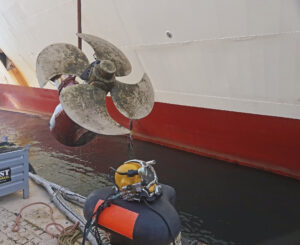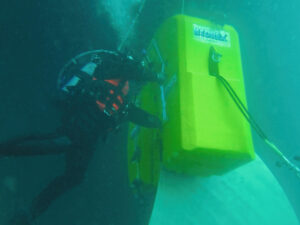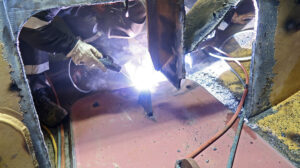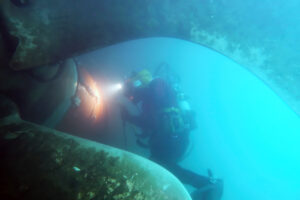

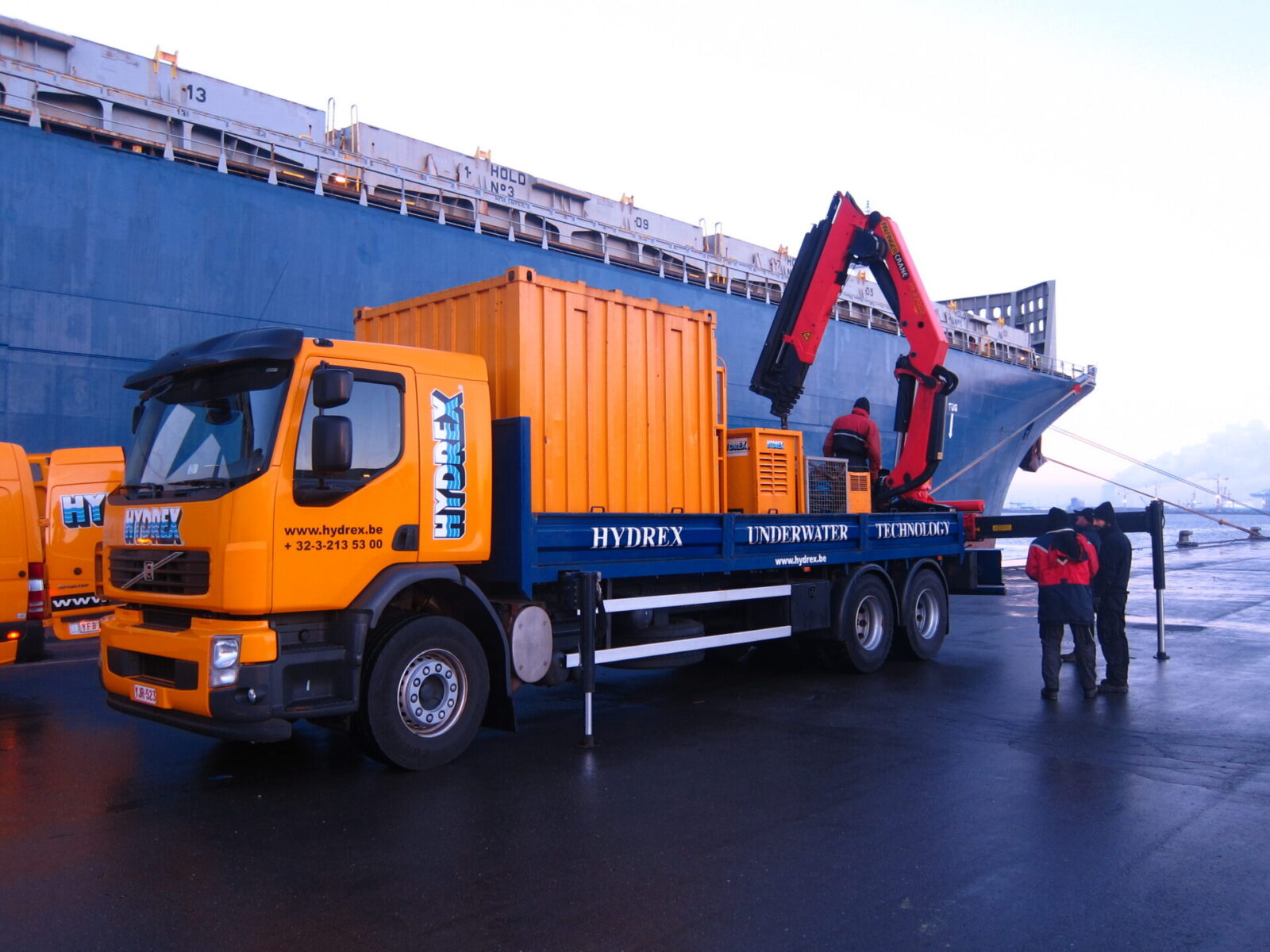
We are able to perform a wide variety of operations with our flexible mobdocks. These enable us to create a dry environment underwater for our divers to work in. There is no need to send the vessel to drydock. We will bring the drydock to you and all operations can be carried out alongside or at anchorage with-out interruption. The lightweight mobdocks allow for a fast mobilization and the necessary adaptability.
Hydrex was the first company ever to use a prefabricated cofferdam for hull repairs, introduced as early as 1979. It was used to carry out repairs to the m/v Lunar Venture. By 1983 the technology was in use to perform insert repairs on double bottom tanks from the inside. We have advanced this concept extensively since then to ensure that fast, professional and class approved work can be done while the vessel stays afloat and even while continuing normal commercial activities. Initially these techniques were ap-plied mainly to the repair and re-placement of bow thrusters. Using steel cofferdams as a mobdock to seal off the thruster tunnel, with an access shaft protruding above the water, work teams accessed the tunnel and from there could work on the thruster in complete safety.
We have since then developed this technology further using lightweight flexible mobdocks (mobile mini dry docks). These were first used in 2002 and have been further developed by our in-house R&D department ever since. Hydrex constantly invests in the research necessary to evolve repair techniques and procedures. It is now possible for our diver/technicians to perform permanent repairs on seals, thrusters and any other part of the underwater vessel without the need to go to drydock.

For many of these operations we work together with OEMs. The most common type of mobdock operations are seal and thruster repairs or replacements. Mobdocks needed for underwater repairs on the standard sizes of seal assemblies and thruster tunnels are available in our fast response centers for immediate transportation. Tailor-made mobdocks can also be designed be our R&D department.
Dry shaft seal renewal underwater
Damaged stern tube seals will cause an increasing amount of oil leaking or water ingress as the damage worsens. By replacing the seals when the damage is first discovered we keep the down time low. Oil leakages can also produce a potential or actual liability when for instance going to the United States or other sensitive areas. When they have a leaking stern tube, ships are often not given permission to enter ports, they can receive fines or are even not allowed to sail on.
By using a flexible habitat our divers create a drydocklike environment around a seal assembly. This enables our teams to perform seal replacements or other work on the housing. These repairs or replacements can be performed on a large variety of seal applications.
It is not always straightforward to replace seals because there can be quite a bit of variation in the configurations of the stern tube itself. There can also be complications with the liners, which can be worn down and show running marks. All this is routinely handled by the teams on the jobs. We usually supply the equipment and the owner is free to supply his own seals. We can handle all type of seals from all original manufacturers.
Case study: Two assemblies, twelve seals, one Hydrex team
A team of our divers traveled to Veracruz, Mexico for a stern tube seal repair. The operation consisted of the underwater replacement of the damaged seals on both assemblies of a semi-submersible offshore platform.
The unit left the field after its project was finished and was berthed alongside to have repair and maintenance work carried out without docking. We were asked to perform the stern tube seal repairs during the available window of opportunity.

After the diving team removed the rope guard of the portside stern tube seal assembly, they performed a thorough underwater inspection of the assembly. Next they installed the flexible mobdock. They then removed the four damaged aft seals one by one and replaced them with new ones. The two forward seals were also replaced during the repair.
All parts of the assembly were then reinstalled and secured. Leakage tests were carried out with positive results, after which the divers re-moved the flexible mobdock. This part of the operation ended with the reinstallation of the rope guard.

All six seals of the starboard side assembly were then given the same treatment. At the request of the customer part of our diver/technician team remained on standby for a short time to make sure everything was in order. When this was the case, they left the platform together with the rest of our equipment.
Bow thrusters
Our diver/technicians can perform a wide range of repair or maintenance work on all types of thrusters. An entire unit can be overhauled, propeller blades and seals can be replaced or repair work on another specific part of a thruster can be performed on-site. These repairs are performed in cooperation with OEMs and can be carried out while the vessel stays afloat with minimum impact on its schedule.
Bow thruster operations are carried out using our flexible mobdocks that close off the thruster tunnel on both sides. These lightweight mobdocks can quickly be transported to any location around the world.

In most cases a thruster overhaul is planned during a scheduled dry- docking. This usually means that the unit is removed in drydock. The ship then has to wait for the repaired thruster to return and be reinstalled before the vessel can leave drydock. This means a longer drydock time and consequent cost. We can how-ever remove the unit while the ship is still afloat so it can already be brought to the manufacturer to be overhauled. When the vessel enters drydock the overhauled unit will be ready for reinstallation without any delay. The reverse procedure is also possible. If the thruster is removed in drydock, we can reinstall it in dry conditions underwater at a later date. In this way the ship can already leave drydock while the unit is still with the manufacturer.

Case study: Replacement in stages keeps cruise vessel on schedule
A 208-meter cruise vessel sailing in the Caribbean suffered steering problems after one of its two bow thrusters malfunctioned. Having to depend on a tug every time the ship berthed would quickly become very expensive. Going off-schedule, however, to have the bow thruster replaced would cost the owner both money and reputation.
A solution was therefore needed that could be carried out on-site without interrupting the vessel’s schedule. Enter our tried and tested flexible mobdock technique and our experienced diver/technicians.
There was only a time frame of eight hour at each port of call during the ship’s cruise in the Caribbean. It was therefore important that the operation was split up in parts that could be finished before the vessel had to leave again. A perfect planning and constant communication between our technical department in the office and our team on location was essential in achieving this.